
Blog
Sensory Activities and Tools: Purposeful, Not Performative
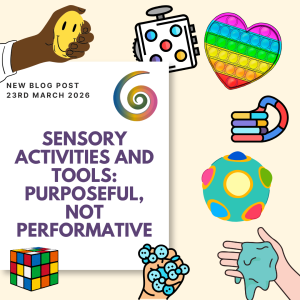
Author: Rachael Ryland
Sensory activities and equipment are often the most visible part of sensory-informed practice. However, they are only effective when they are purposeful. A wobble cushion, a weighted lap pad, or a box of fidget tools does not regulate a learner simply by being present in the room. What matters is understanding why a tool is being used, when it is likely to help, and how it is introduced and monitored.
Sensory tools should always support access to learning. They are not rewards, distractions, or entertainment. They are regulatory supports that help a learner’s nervous system remain organised enough to engage.
Where Do General Sensory Fidgets Fit?
Not all fidgets are regulating. A tool is only helpful if it improves a learner’s engagement with learning. If a learner is watching the fidget rather than the task, making noise with it, using it to gain social attention, or appearing more unsettled than before, then it is no longer serving a regulatory purpose. In that moment, it has become a distraction rather than a support.
It can be helpful for school staff to pause and reflect on what is actually happening. Is the learner more focused while using the tool? Does the movement seem repetitive and automatic, almost happening in the background, or is it visually captivating and drawing attention away from learning? Is restlessness decreasing, or increasing?
Some popular fidgets, particularly those that are highly visual such as spinners, can move a learner from regulation into stimulation. This is especially likely if the learner is already dysregulated.
In general:
- Firm resistance = more regulating.
- Highly visual or noisy = more stimulating.
| Fidget Type | Primary Sensory Input | How It Helps | When It May Be Helpful | When to Be Cautious |
| Fidget spinners | Visual + light tactile | Repetitive motion can support focus for some learners. | During passive listening tasks if used without visual fixation. | If the learner watches it continuously, spins rapidly, or shows increased arousal. The visual element can be overstimulating. |
| Popper toys | Tactile (repetitive pressure) | Provides predictable, rhythmic finger pressure that can calm anxiety. | During seated work where hands need engagement. | If used loudly, rapidly, or as a game rather than regulation. |
| Tangle toys | Tactile + light proprioceptive | Repetitive twisting motion can support sustained attention. | During reading, listening, or quiet tasks. | If manipulated above the desk or used for social attention. |
| Ball fidget toy puzzles | Tactile + cognitive engagement | Can occupy hands and provide structured focus. | During waiting periods rather than instruction-heavy tasks. | May become too cognitively demanding and compete with learning. |
| Button clickers / sensory click tools | Tactile + auditory | Repetitive pressing may reduce restlessness. | If the sound is minimal or muted. | Audible clicking can distract others and increase sensory load. |
Matching the Tool to the Need
A common pitfall in sensory-informed practice is relying on a “toolkit” approach, where more resources are added without clear purpose.
Instead, effective practice is:
- Observational.
- Responsive.
- Individualised.
It is less about what is available, and more about how and why it is used.
This requires an understanding of:
- The learner’s sensory profile.
- The current state of their nervous system (calm, alert, overwhelmed, fatigued).
- The demands of the task or environment.
For example:
- A learner who is under-responsive or fatigued may benefit from alerting input.
- A learner who is overwhelmed may need calming, predictable sensory input.
The same tool can have different effects depending on these factors.
Introducing and Using Tools Effectively
How a tool is introduced matters just as much as which tool is chosen.
Good practice includes:
- Clear modelling of how and when to use the tool.
- Explicit expectations (e.g. “hands stay below the desk”, “this is for helping your focus”).
- Limited choices to avoid overwhelm.
- Regular review to check whether the tool is still helpful.
Tools should feel supportive, not novel or distracting.
Sensory tools can be powerful supports when used well. They can help learners feel more settled, more focused, and more able to engage. But they are not a quick fix.
The impact comes from the thinking behind them: understanding the learner, recognising the purpose, and using tools in a way that genuinely supports regulation rather than simply looking like support.